Showing posts with label FRIM. Show all posts

Wednesday, January 30, 2013

FRIM nature walk "Aliens" with MNS 13 October 2012

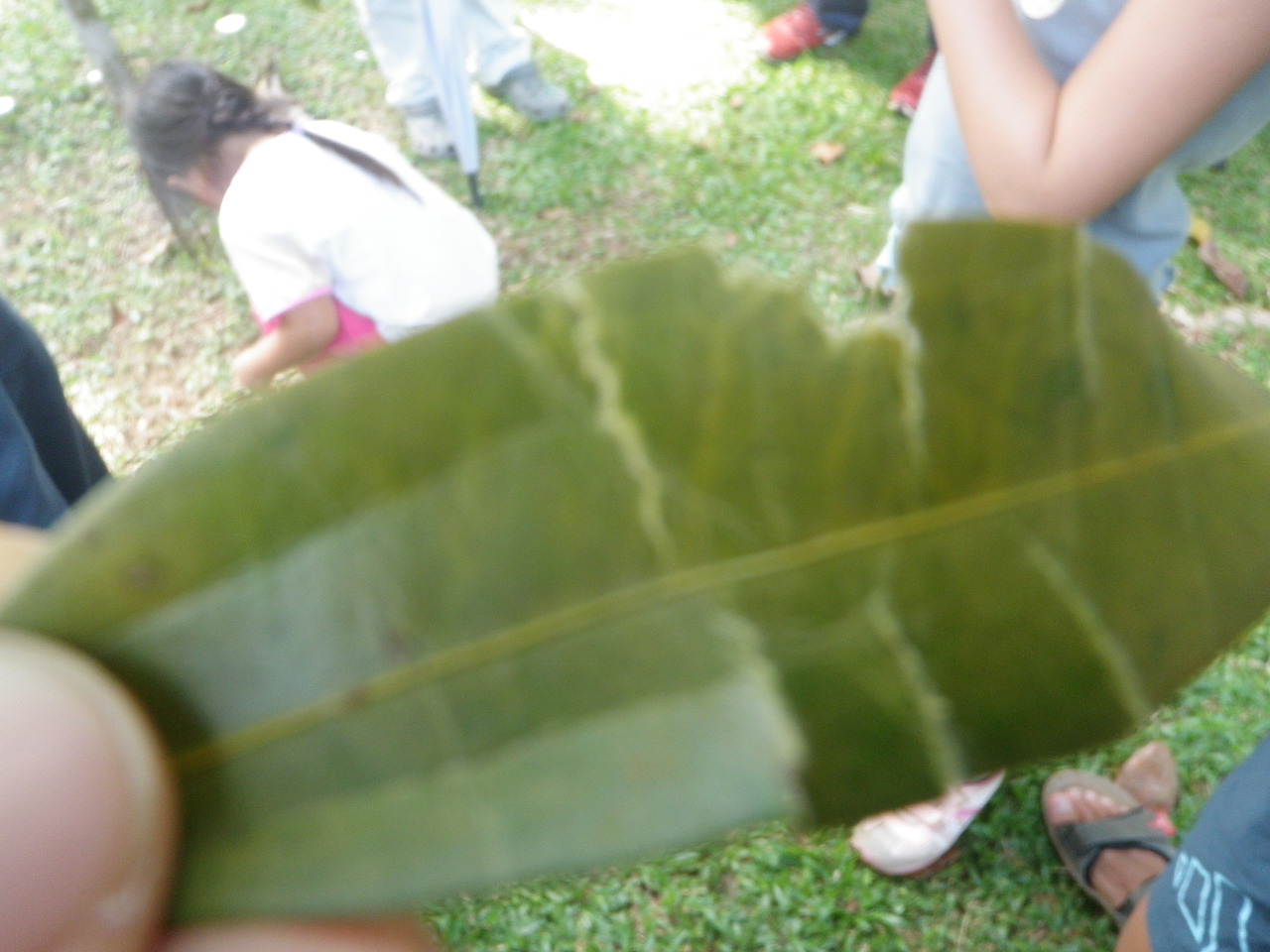
Leaves of Camphor tree. 
The older one commented it smells like tiger balm whereas my younger one here, said 'basil'.
We were told that the wood of Camphor tree has a strong nicer fragrant and it is sold at Daiso.
 This is the only tree that originated from Japan over in FRIM.

 Ming, a botanist and MNS nature guide of our group.

Trumpet tree came from tropics America. Its leaves look like an umbrella and it is very similar to our local tree, Mahang. Fruit is small and is very popular among the bats which helps to spread the seeds. 

Dumbcane is a popular house plant and it is commonly seen. Little did I know that should our lips are in contact with the sap will cause one to be not able to talk for a day or two!

Bougainville's flower is just the small white one in the center. The pink colour part is a modified leaf called bracts. Interesting!

Hibiscus originates from China and it is known as China Rose! 

  Adancum piper (pepper) plant is one of the top 100 most invasive plants. There is a whole plantation of it at Guang Nuang. A crushed leaf will help in stopping bleeding when it is rubbed on the wound.

This tree here is dubbed as "Malaysia Sakura". It produces pink flowers during Chinese New Year season and lasted only one to two days. 

Acacia Mangium is also one of the top 100 most invasive plant here.
The photo in the middle shows its branch and its twig, which look like a leaf! 
The twirly one is the fruit. 
The bark is rough and mostly not healthy and could tumble easily as the tree is not suitable for Malaysia climate. 
The tree is planted for paper but it doesn't produce good quality ones

.  My older kid chasing after Ming and talking to her. 
Seriously, children doesn't need a school setting with hundreds of people to be able to socialise.  

Sunday, April 22, 2012

Making Waterscope and quadrat at FRIM 16 April 2012

Our water scope torn apart after using!

Measuring the quadrat by some older children.

Tuesday, February 28, 2012

Leaf or Bark Rubbing at FRIM (Forest Research Institute of Malaysia),Kepong 21 February 2012

Being outdoor, close to nature is the best classroom of all. 

20 children from age 4 to 10.
With the internet, so many good and free resources available. 

Bark and leaf rubbing.

Some kids sat on the mat, some on the ground, etc

Building a dam.

Cold dip on a Tuesday morning. 

Friday, June 3, 2011

FRIM nature walk with Malaysian Nature Society 28 May 2011

Saturday 9am
It's our first MNS outing as MNS members at FRIM for a nature walk, identifying 16 plants. We enjoyed it tremendously. EnHui love nature and usually will pick up lots of things as they wander about. 

Jelutong tree, the very first plant where we started at B8. The baby and grandfather Jelutong trees are just next to the car park.

Information sheets are provided. Cool!

Briefing by our MNS guide, Ming.

Ming letting Hui touched the sap from the Jelutong leaves, which is used to make chewing gum!

Pagoda-shape branching of a Jelutong tree.

This is Tembusu where its bark has deep grooves. 

Tembusu 's fruit.

small cup formed at the leaf axil.

Often, Tembusu is home to a type of stingless bees colony.

 Found a bee hive that fell off the Tembusu tree bark due to its own weight.

Damar minyak tree. Try touching the minyak at the tree bark.

Damar Minyak' s fruits. These are males. Female is like a round golf ball and hard to locate.

Fruit of a Kulim tree which smell really bad, like onion.

Leaf of Tongkat Ali, when folded and reopen, it's creased but not easily torn. When you tear it, torn edges are not smooth but with fine thread-like fibres.

Ming asked us to guess if this is a wood or stone? En replied "It's a wood and stone!".
Ming said "She is right, it is both wood and stone"
I guess perhaps we have been to this exact location twice with a guide from FRIM but she wasn't paying attention at all at both occasion.

Check the massive root network.

As usual En went about collecting her treasures (she said) and found this curled up hairy stuff. Ming said it is a part of a plant when En asked her about it. En called it 'hamster'

The other members checking on En's treasures and the so-called 'hamster'.

Penaga Lilin's leaves pops when burnt. This is because a layer of waterproof wax-like film coats the underside of the leave and this film traps air

We ended the tour at B8, also where we started, at Plant no 16 which is called 'paku' and you know what, the whole plant is poisonous! En Hui were picking wildflowers near the 'paku'. I am holding a bunch of Penaga lilin's leaves to 'play' at home.  

I don't know why, somehow I remember some facts after this trip where I usually don't as I never pay attention and I never bother to. One more fact, our forest is a dipterocarp forest. Di means two. Ptero means wings. Carp means fruit. Check meranti seed on this link and you know what I mean by Dipterocarp.

Not a MNS member yet?  Come and join us.

Tuesday, April 19, 2011

FRIM Tissue Culture Lab 14 April 2011

ler Thursday 915am
We joined a tissue culture lab outing, organised by YL.  Having her, a marvellous and experienced science teacher onboard is wonderful. It is such a great help for me who knows nothing on science and not knowing where to proceed on unschool science. :) I am thankful!  

The kids mingled with each other at ease. Be it a new kid on the block or old friends. On the other hand, I have gone through years of socialization in school, found it tough to break the ice and socialize when meeting new mothers.

B6 - that's where the Culture Laboratory is located. (opposite D6,  Customer One Stop Centre)

According to a curator, he was not aware of our group visiting the lab! The staff removed the glasses from the table as we walked into the lab with a bunch of young children, below 7 years old. :)

Dr Noh Hasnida, a senior reserch officer shared her knowledge with us.

Due to safety reason, only 12 years old and older kids were allowed to enter the lab. 
 Dr Noh Hasnida was accomodating and somehow agreed to let younger children, aged 7 and above to step in.

En entered on her own with  aunty J, where I stayed outside, taking care of the little toddlers.

Hui, led the others, played games on the table!

After the lab visit, we were led to the Museum and trekked the jungle through Keruing trail. The guide who led us, was also our assistant guide on our FRIM field trip in14 December 2010.

Perah tree, is where Camp Perah, FRIM derived its name from.
I  have visited the campsite, with the intention to camp there but found the place with no river or stream for children to dip.

wahhhh oooohhh the sure response you will hear from people who sees it for the first time. :)
Today, I learnt that when the leaves meet, they will drop off hence leaving the wonderous and mysterious gap.

The nickname of this tree is toilet tree! It looks like a cubicle.

Some marks left by a wild boar.

Today, we trekked further into the jungle than our previous trip. The area was damp and we spotted different types of beautiful fungi.

Another fungi which we have not seen before.
The fees for this field trip is RM3 per person, aged 5 and above. There is no charge for aged 4 and below.